Sunday, 13 May 2012

No longer a Ferenji

Been back in Toronto for a week now, more or less over the jet lag, and trying to put things in perspective.

I was quite relieved in a way to study the UN Human Development Index (a measure of wealth, education and health) and find that Ethiopia was 174th out of 187 countries listed.So what I saw was fairly close to the bottom of the barrel, almost as bad as things get anywhere in the world. One way to look at is that in Ethiopia they only have two phones for every 100 people (including both cell and land-line phones!).

There is some money in the country - a lot of stuff is getting built in Addis and in Gondar, and there are some nice restaurants, hotels and shopping malls, but overall its still a very poor country with little money. GDP is $848 per person, of which 2.2% or $19 is spent on health care.

This explains why everything in the hospital was pretty much as cheap and nasty as you could imagine, from the IV tubing which always kinked to the IV bags which had no injection port, the re-used endotracheal tubes and spinal needles and to the paper in the charts which was thin, grey and friable.

Medical education does seem to be a priority, and there are lots of smart students at all stages getting quite a thorough book knowledge of how to provide medical care. I cannot imagine that, despite the best efforts of TAAC and similar groups, they will choose to stay in the country. As we talk about dining in Ethiopian restaurants in Toronto, we make it obvious that they could emigrate and yet preserve much of their cultural life overseas. As we talk about how we care for our patients in Canada, it shows how much better medical care they could provide for their patients if they practised in a developed country. When we fly to Lalibela for one weekend and Gondar the next, we display mind-boggling disposable income to people who have lived all their lives in Ethiopia but only sees a few of the sites of their own country. Why stay and work in a hospital with an intermittent supply of running water in the operating rooms and only one ventilator and no ABG machine in the ICU when you have heard of what else is possible? I don't think you can build a modern health care system on the money currently available in Ethiopia. Maybe if these residents go to work overseas and send money back to develop the Ethiopian economy, that's the best thing they can do.

On a more personal note, Addis is just not my kind of City. It is too new, too big, too polluted, too lacking an natural or man-made beauty. If it was in Europe or North America, there  would be no reason I would ever go there. Also, maybe teaching residents is not what I do best. I found the university atmosphere , where everyone watches and assesses everyone else, rather constricting., and our mandate, to do what we are asked to do and only teach the residents, without looking at the broader system in which they work, too limiting.


Friday, 4 May 2012

Strange things inFrankfurt

Arrived a little early at Frankfurt. Could not figure how to pay for WiFi so using a kiosk.
Tried to check my email but could not log on. Went to this site and was logged in automatically. Weird.

(Don't know what the issue was , maybe I was just jet-lagged and confused by the European keyboard and a slow connection)

Fistula Hospital

There are lots of hospitals in Addis, but probably the most famous is the Hamlin Fistula Hospital, which is where Dr D and I spent our last afternoon in Addis.

The basic story is that many years ago the Hamlins came to Addis intending to improve the care of pregnant women. They found women with fistulae who no-one else was caring for and devoted the rest of their lives to trying to fix this problem.

The basic issue is that many Ethiopian women are under-nourished and then have children when they are too young. The babies get stuck, and without any access to obstetric care, after several days the baby dies and the mother suffers injuries to her bladder and bowel, which leave her leaking urine and/or faeces. This makes her a smelly outcast, rejected by her husband and family, left alone in a basic shelter with nothing to do but wait for death.

Thanks to the fistula hospital many of these women can be fixed, and return to their families in good health. The hospital provides comprehensive care, including preoperative nutrition and physiotherapy for those who are too undernourished and deformed to be ready for surgery. They can do urodynamics to assess patients, and if necessary they will do a urinary diversion and create an ostomy if no other solution is possible. Women who do not wish to return to their families are considered for positions as nurses aides.

The enterprise has been wildly successful, with supporters from around the world, notably including Oprah Winfrey who built a new wing. They have now developed smaller hospitals to do the simpler cases in cities across Ethiopia, have set up some small businesses for their ex-patients, and have just now graduated their first class of midwives. Fistula is a preventable problem, which hardly exists in developed countries. If women have decent care in childbirth and can be referred to a hospital early for a CSection, the problem can be avoided.

We were shown around the beautiful grounds, and the spotlessly clean wards, where we met Catherine Hamlin, who was a very gracious host and spent quite some time talking to us about the hospital.

Photographs are not allowed, but you can learn more about the hospital and make a donation at  http://www.hamlinfistula.org/

Djibouti Fini


What to do with my last night in Djibouti-ville?
A band called Danakil were playing at the Salines Theatre, so I went to see what that was about. Half an hour before show time the only people there were riot police. Scratch that idea! I wandered around the market area, which felt safe even after dark. A few touts want to show you stuff, but if you look at a few things and say “Non, merci” they leave you alone.

What to do for dinner? The boring thing would be to go back to the pizza place I went the first night, the more adventurous thing would be to search out some “poisson Yemenite”, the local baked fish specialty. I found a place on the Rue d’Ethiopie which had a name similar to the one which Lonely Planet recommended, but which has gone out of business. They had no menu but seemed to be doing good business, so I asked if they served poisson Yemenite and they were pleased to be asked, and insisted I go back into the kitchen to pick my fish out of the fridge. They all seemed rather large, but the deal was they cost “deux milles” – about $ 12 – with all the fixings. The waiter was arranging a chair and table for me, so I seemed to be committed. He quickly bought a bottle of water and a glass, which was welcome as the place was hot even at 8 pm. This was followed with some limes, a pink frothy dish which turned out to be made of tomatoes, cream cheese and milk, a galette (which was a huge naan-like bread but with a big central cavity) and the piece de resistance, a whole fish, cut up the middle, with a splash of hot red sauce in the centre, and baked till dry and crisp on the outside.  My medical colleagues would say I was well into the “Cipro chaser” category here. (Ciprofloxacin is an antibiotic used to treat severe cases of traveller’s diarrhoea.)

The galette was delicious, the tomato cheese dip pretty good, (but I felt that was the most dubious item to eat) and the fish was tasty but had lots of bones. I managed about half of everything. I was not very hungry and I was aware that the more I ate the more likely I was to get any bug that was going around. The waiter was very friendly and apologised that this day’s catch had not included any smaller fish. So far, no ill-effects!

Today I packed up slowly and reluctantly, enjoying the facilities of the hotel right up to check out time of noon. Wandered to the almost abandoned station of the decrepit Djibouti-Ethiopia railway, then decided it was time to make like a real tourist and head to the Kempinski Hotel to use their beautiful infinity pool. It was full of American soldiers, making it just about the only place in Djibouti where you hear English.


I got the worst taxi driver back to my Hotel. He kept on calling me “my friend” and wanting to arrange to take me other places, while driving too fast and playing explicit English-language rap loudly on his iPhone. He then claimed not to have any change so I just sat in his cab till he found some.

Got a Fanta at the kiosk at the airport. After the shopkeeper had opened the bottle, I found out she did not have change for a 5,000 DjF (about $30) note. I drank the drink slowly, then returned to try to pay again, but she just waved me off, saying it was a gift!

That would have been such a cool last encounter in Djibouti, but I still had to change my residual money into dollars. The airport is pretty basic (no A/c, no WiFi) so I was doubtful there would be an official bank after going through security. This lleft me changing money with the rather shady guys at the convenience store, who stiffed me out of about $8! But I had guessed right, if I had not changed it then I would have been stuck with the money in Djibouti Francs, which are not exchangeable outside the country.

No ill-effects from the fish so far…

Wednesday, 2 May 2012

Lake Assal

Just back from the lowest point in Africa, and the saltiest lake in the world!
Lake Assal is a dead sea of salty water, 150m below sea level, and the third lowest point in the world.

The start of the drive was depressing as we passed through acres of dusty yards with dozens of trucks and tankers which take stuff by road from Djibouti to thee land-locked Ethiopia.
The I saw three camels wandering down the middle of a four lane paved highway!


Gradually we moved out of the city into a bleak landscape, dry dusty and rocky.The local Afar people live in "bungalows" made of twigs and course fabric:


They depend on the government to refill blue drums of water by the roadside, as there is so little rain:


The lake looks rather like a Canadian lake in winter, with white stuff collecting along the shoreline, but its almost 40 degrees above freezing, not below!


I bought a small packet of salt spheres, about 4mm across. This is a rare form of salt, and the subject of an article on the salt news website (link below). I paid 200 DjF, just over $1. My driver paid 500DjF for a similar packet of regular salt, which I was offered for 100 DjF! Am I better at haggling or am I just mean?

Its hard to imagine how impossibly tough life must be for the Afar nomads, its almost like the Inuit surviving in the Canadian Arctic. The article below suggests that all they want is to continue in their traditional life, but with a little more water. I think I would be walking the hour or two to the few small schools available in the hope that one day I would get a job in an air-conditioned office!


Links:
http://www.saltnews.com/2010/08/djiboutis-mystery-salt-from-lake-assal/
http://news.bbc.co.uk/2/hi/programmes/from_our_own_correspondent/9254468.stm

Tuesday, 1 May 2012

Chillin’ to the max on Isle Moucha


Took a cab to the stunning Djibouti Palace Kempinski Hotel and admired the infinity pool and swim-up bar beside the Red Sea. Walked down the pier to a small (maybe 20-seater) boat with two 200 HP engines which shot off like we were running drugs for the 20 minute ride to Isle Moucha. We stopped just short of the island to watch dolphins swimming alongside our boat.

Stopped at Blue Lagoon, a small beach with a bar, dive school and a few thatched beach umbrellas and beech chairs. Arrived at 8:30, left at 5 pm, the only excitement was a buffet lunch.


Swam several times in the warm clear water, had a couple of drinks, finished two books, listened to my iPod. That was it for the day.

Came back and took a cab directly to Sept Freres, a highly recommended restaurant for the local specialty, baked fish. It looked a bit run down, and it turned out that it was out of business. I walked back to my hotel for a shower and change, I am now thinking about a plan “B”.

Monday, 30 April 2012

Djibouti 2


This is more my kind of Africa.

Well, apart from the heat. I would be exaggerating if I said that as I walked sweat dripped from each of my fingers, but it is pretty close to that!


View from bedroom window


Got up at 7:30, had a shower, had breakfast – fresh juice, omelette, baguette with jam and Lurpak butter, coffee – and headed out. By 10:30 I was back in the Hotel for a shower. Now it is noon and I am back for my third shower and I think I will hang out in the airconditioning for a couple of hours to avoid the mid-day sun.


Pretty much done the town. Went to the bank and changed some more money, as tomorrow is a holiday. Went to a tour shop and booked a one day trip to Moucha Island  for tomorrow. Bought a couple of postcards and stamps.  Found a nice French restaurant – Le Poirier – for dinner.  Went to the supermarket and bought about 4 litres of various liquids. They sell meat the way it should be, shrink wrapped on polystyrene trays, European brands of jam, Lays French Fries with Arabic labels, and Activia yoghourt at $10 for four.


Bought a wallet to replace the one that was stolen and a pair of flip-flops to replace a pair that are falling apart.

Went to the main market, which was amazing! Incredibly picturesque, but they did not like me taking photos so I stopped and just looked. Its dirty and packed enough to feel African, but not so decrepit or congested to feel threatening, especially when you only bring $30 in cash with you!  It covers maybe five or six city blocks and is sorted of organized. Electronics in one area, restaurants in another, sarongs here, shoes there. I was looking at sarongs, but 75% of them, including all the nicest ones, are made in Indonesia and I would prefer to buy one made in Djibouti.


 I  cant find the adapter to connect my camera to my computer so I cant see or post my pictures. If it does not turn up after my siesta I am sure I can find someone to sell me a replacement. (I found it!)

Sunday, 29 April 2012

Arrived in Djibouti


Just had a warm bath and am watching BBC TV in my air-conditioned room with decent lighting which I can turn on and off from my bed. Simple luxuries which are now greatly appreciated!  I have been out to have the best pizza since leaving Canada, with some Belgian beer and some ice cream with chocolate sauce for dessert.

The flight landed on time, the line up for a visa was short, then I bought some Djibouti francs at the convenience store at the airport. A taxi driver offered to drive me into town for 2000 francs. There are supposed to be 177 Djbouti Francs to the dollar so that’s about $12whcih may be a bit over the top but not enough to fight over.

Djibouti City is about 5 km form the airport. All the signs are in French. It’s a fair bit cleaner and tidier than Addis, but a lot hotter. There is less contrast between the buildings, all look to be reasonable, with less obvious poverty or wealth.  It looks vaguely like the south of France or New Orleans, with Arabic influences

I was checking into the Hotel Menelik, where I had a reservation, within 30 minutes of landing. The hotel staff seem very friendly and organized. The Hotel is on the main square in the downtown core of the European Quarter, surrounded by shops, bars restaurants and night clubs.

The usual touts are everywhere, people claiming to be friends that I met at the airport. There is 40% unemployment, so what else can people do? My latest trick is to reply to everything they say in German, as best as I can. So far none of them can understand German. It’s a good intellectual exercise, but it does not make the touts shut up or go away.

I visited a couple of book shops to see the local picture books. Oh dear… one of them has a series of pictures of the major roundabouts of downtown Djibouti! The beach at the best hotel in town looks a bit muddy and unwelcoming. The islands I thought I might visit are dry and featureless. There is a nice looking lake, however.

Djibouti clearly is not a major tourist hot spot. I am already beginning to recognise the few groups of foreigners in town, and they are all francophone. I have also found a couple of the offices which can organise tours.

The hotel has free Internet but so far the only web site which works is Gmail. Don’t really understand how that can be. Will try to post this and see what happens!

All on my own-io


I think this is the first day on this trip I did not set my alarm clock. It’s not actually very necessary when the mosque does call to prayers at 5 am. This time after it woke me up I was able to get back to sleep for a couple more hours, then wake up slowly and potter around.

I have the apartment to myself. Dr D got up about 5 am to get a flight to Mekele. That meant that when I woke up I could use his en-suite toilet, the one that flushes, instead of mine, which relies on a bucket of water from the shower. If I had been so inclined, I could even have shaved using his hot water tap!

Dr D’s doing a tour around Mekele, Axum and Gondar. I should be meeting him on Friday afternoon to tour the fistula hospital before we each catch different late Friday night flights back to Canada.

Dr A is at the hospital, helping the Norwegian do a workshop on fibreoptic intubation and the use of the glidescope. I don’t expect to see her before I leave for the airport for my flight to Djibouti in a few hours. She flies back to TO on Monday night.

After all the rush of work, lectures and social activity it is nice to have a while to sit and think, and not much to do for a few hours. It is going to be strange to go to a new country all by myself. Maybe the last time I did that was when I went to New Zealand in 1982!

I hope I enjoy Djibouti, and that I am not getting too old to enjoy travelling to new third-world places. I have not really taken to Addis, but it’s a large smoggy city with a lot of drab soviet-style architecture left over from the Derg regime. For a while I had a cold and was under the weather, and then I was pick-pocketed. The apartment is quite spacious, but it is in a rather boring middle class area with a lot of embassies. There are a few decent restaurants in the area but we are bored with all of them by now. Parts of the downtown area are interesting but the begging mothers with babies on their backs are getting to me, and I am too suspicious of everyone who wants to start a conversation with me.

I don’t see anything in the shops I want to buy. Everything Ethiopian seems to be rather odd, not something that would fit in back in Toronto. The art at last night’s restaurant was very interesting and vibrant, but a lot of it included religious symbolism  that I did not understand. The most fascinating was a series of street scenes where the artist had stuck artificially contrasty bits of colour photographs onto the canvas and then painted around them and over parts of them.

I guess downtown Addis does not have much of the sort of things I am interested in. Dr D is interested in Ethiopian music and passionate about coffee. Dr A. is into girly shopping for ear-rings and other fashion items. Both of them have bonded with the residents over their shopping expeditions in a way I have not been able to. My interest is more in the landscape and mountains, so I enjoyed walking in Entoto, hiking in the Simiens, and the Mountainview Hotel in Lalbibela.

I should stress again how nice most of the people are here. I went into a pharmacy to buy some nail scissors, just about the only thing I forgot to pack. (All air travellers should carry nail scissors in their hand luggage; it gives security something to do, and it makes them feel like they are winning the war on terror when they confiscate them!) I thought they were asking 50 birr, but they refused my 100 birr note and my 50 birr note, then wanted two of my tens. I was a bit confused but started to walk out of the shop with my purchase when they called me back to give me 5 birr change. The price was 15, not 50, a confusion which is so common here many taxi drivers will say “five zero” to avoid confusion. I hate so say it, but if things were the other way around I am not sure I would be so honest!

Fourth Annual Conference of the Ethiopian Society of Anesthesiologists Professional Association


In a way I was looking forward to this conference, as in Ethiopia I am more comfortable delivering a prepared speech than giving anesthetics, but my expectations were fairly low, especially as the schedule was not finalized until the afternoon of the day before.

The three of us dressed smartly, and a driver came to take us to the Desalgne Hotel just off Bole Road. This is a spacious and glitzy hotel. We went up to the fifth floor conference rooms, where there was the usual sign-in sheet, free notebook and pens, and a couple of snappily-dressed drug reps selling halothane (?!) and haemacell. Had a chat to them about bringing drugs into Ethiopia. The government maintains a national drug list, and they need the support of the anesthesiologists if they want to get anesthesia drugs in. If the pharmaceuticals are manufactured in India or China there has to be a government on-site inspection of the manufacturing plant, which may be a wise precaution.

After a coffee, there was the usual welcome speech, and an apology that the Ministry of Health was unable to send a delegate.

There were 75 people in attendance, including all our residents, anesthesiologists from the police hospital, army and various private hospitals in Addis, and some from other cities like Jimma. There seemed to be a few anesthesia nurses there, too.

Dr A gave a talk on nosocomial (hospital-acquired) infections in ICU. I was not surprised when she said they were three times more common in developing countries. Just looking at the Black Lion ICUs, with limited water supplies, no clean towels, few gowns, and patients close together it’s not surprising. She offered some cheap suggestions (like nursing patients 30 degrees head up, and feeding as soon as possible), some more expensive ideas (like total body draping, gowning and gloves for central lines), and some thoughts about designing the new ICUs which are apparently in the works in various hospitals including Black Lion, to reduce spread of infection. It was a good talk and well received.

At the coffee break they served delicious small chocolate covered donuts, and we could get some fresh air on the fourth floor balcony.

A local anesthesiologist presented a case of tonsillectomy in a four year old with undiagnosed laryngeal stenosis. After several attempts he got a 3.0 tube in, and the surgery and extubation were uneventful. This led to a good discussion. I suggested that nebulised epinephrine would have been useful if the kid had developed stridor. We talked about using the LMA as a rescue airway or even for the procedure, and I was surprised to find that even in a private hospital they did not have a suitable LMA for a four year old child. We discussed surgical airways and I referred to a British review which said that emergency surgical airways in kids have a poor success rate. Finally, there was a discussion of how to ensure that subsequent anesthesiologists knew about the problem.

A drug rep was then given ten minutes to talk about his company and the products they had in the pipeline, which was interesting but would not have been allowed in Canada.

There was an excellent buffet lunch. National food – injera and wot –  supplemented by an array of salads, some pasta, a couple of stews, some bits of chicken, followed by small bits of cake and fresh fruit.

Dr D then gave his paediatric talk, covering recent controversy in fluid management, the assessment of the ill child, and recent changes to ACLS protocols for paediatric cardiac arrest. It was all good stuff, but he needed more time to cover it, and the program was kept strictly to schedule.

I then talked about Day Surgery, which seems to be a new idea in Ethiopia, where many patients wait a long time for minor procedures because of the lack of surgical beds, when they do not need to be admitted.  I went over the logistics of running a Day Surgery unit in detail, then showed what we do at The Scarborough Hospital Eye Centre as an example. People seemed interested in the idea, but unsure how to get the ball rolling. There were specific and valid concerns about how to set up a system so that patients who had problems after they had gone home could contact the hospital and be re-assessed and possibly admitted. Black Lion can be a crazy busy place and you can’t just assume that patients would be able to telephone someone and get seen promptly.

I had some interesting conversations in the coffee breaks. I met one of the two medical anesthesiologists from Jimma, a university city about 200 km from Addis. They are opening a new surgical suite with 12 ORs, and starting a residency training program with six residents! OK, he has a large group of nurse anesthetists to help out, but every other night they will be calling him for telephone advice or to come in for difficult cases. Not surprisingly, he is looking for outside help! Unfortunately I think TAAAC will be very busy serving Addis, especially as they will be getting six new residents next year, and CASIEF has recently added a project in Palestine to its ongoing work in Rwanda, so I can’t see either organization being able to offer much more than moral support.

There was a members-only business meeting of the association so we read papers in the lobby and hung around until that was finished, then went with the residents in a hospital van to an Italian restaurant in a local art gallery for dinner.

It was a very good day’s work. As we had been in Addis between two and four weeks, we were seen as professional colleagues, not just a bunch of western dudes flying into Africa to teach the natives how to do things. Overall they have a realistic model of anesthesia care, with nurses providing most of the routine care, under the supervision of medical anesthesiologists, and physicians doing the more complicated cases. Hopefully, the surgeons will come to appreciate that for the more difficult cases, physician anesthesiologists can provide better preoperative assessment, better intra-operative management, better postoperative pain relief, and, if necessary, high quality intensive care, and that all these will result in better outcomes for their patients.

The Professional Association has a lot of work to do, getting the message across to the Health Ministry that high quality anesthesia is an essential part of health care, and that they need the drugs and equipment to do the job they have been trained for. I hope that eventually they will be able to write guidelines for anesthesia in Ethiopia. For example, if they develop the standard that every intubated patient should have a sterile single-use endotracheal tube rather than a washed and recycled one it will be easier for anesthesiologists across the country to insist that their hospitals supply them.

It will be a long and had struggle, but I think that it is very worthwhile, and I am proud that I have been able to play my small part in supporting Ethiopia’s anesthesiologists.


Friday, 27 April 2012

Sheraton Addis

I have just finished my last say working at Black Lion and decided to celebrate by walking up to the Sheraton and eating a salad. It must be safe to eat uncooked vegetables here, surely?

The hotel is huge and impressive with extensive manicured grounds, but this is the first time I have tried to use a keyboard with ge'ez script (used to write Amharic) as the main text on each key, and roman script as a small superscript. The browser is IE 8 on Windows XP 2002, whcih is not supported by Blogger so things look a bit odd.

I think we are all getting a bit tired and weary. At first the residents seemed very bright and enthusiastic, but as time wears on we realise that a few of them have major punctuality problems and that some of what we say goes in one ear and out the other. Its time to move on.

Tomorrow we are speaking at the 4th Ethiopian Anesthesia Meeting. The program was finalised a few hours ago, I am giving the last talk of the day, which is a pain but someone has to get that position
.


Thursday, 26 April 2012

Hospital Cafe

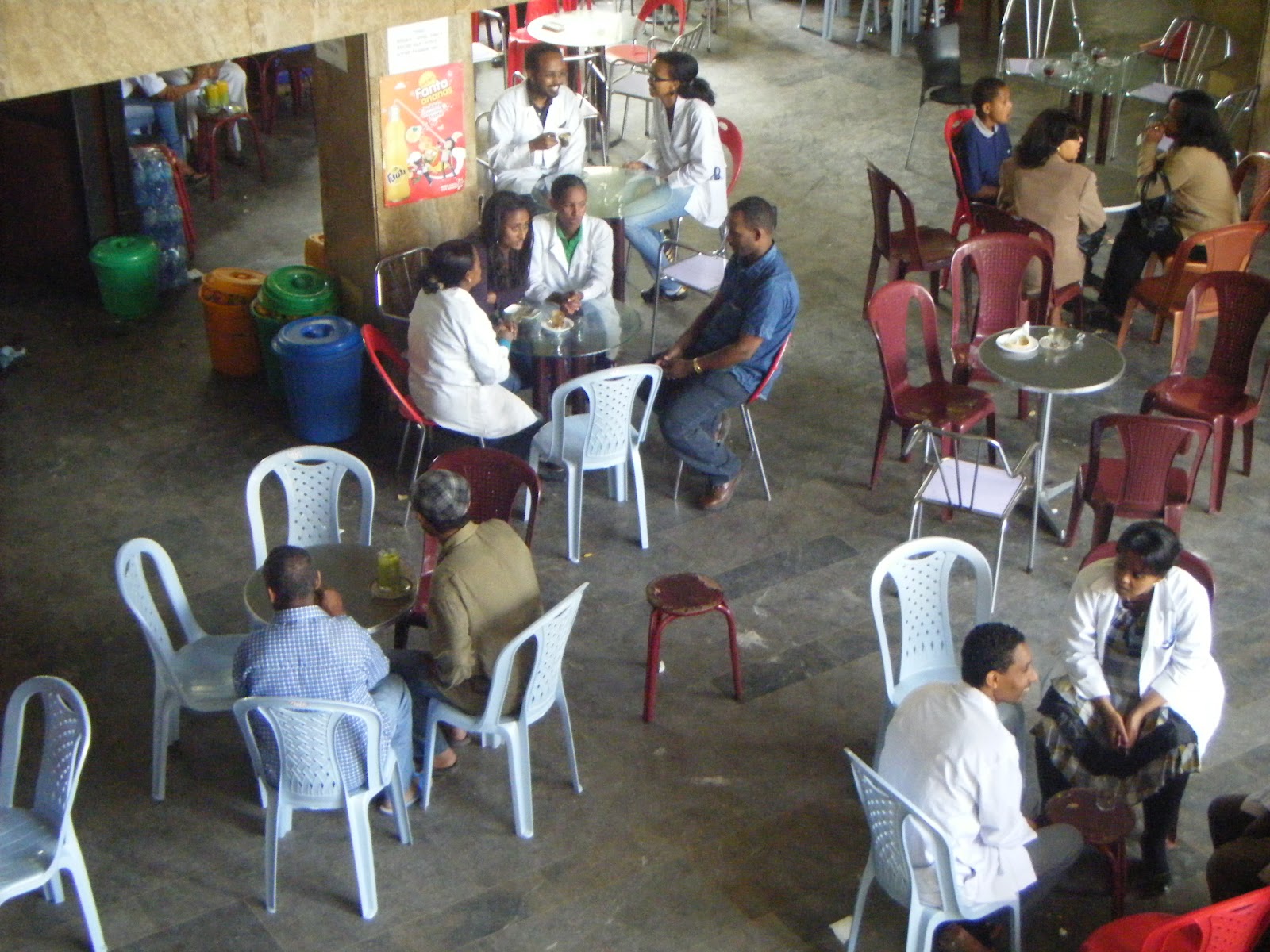
Everyone hangs out at the cafe in the lobby. It is a great place to meet anyone who is working at the Black Lion. We try to get there every morning in time for a coffee, and for lunch a juice and cake or doughnut.


The best things they do are the macchiato coffees, small strong and sweet in very delicate little cups:


They also do mixed juices, which are in fact pulped fruits which they make on site, usually with avocado and mango, with a small strawberry layer on top if you are lucky. Its served in a tall glass with a squeeze of lime:


I will miss those drinks, as I don't think you can get quite the same effect anywhere else!


Got paid and going to Djibouti!

When I signed up for this trip I had to enter into a contract with the University of Addis Ababa, which was a bit of a pain. For example, I had to get a physician's letter to say I was fit to come here. One item was that they would pay me $1,000 US plus living expenses. I pretty much forgot about it. When you are taking five weeks off, its not a lot of money.

A couple of days ago a secretary reminded me, and since then I have been harassing her to get things sorted out. Yesterday she said it was fixed for 9 am today, so I went to her office and to my surprise she was putting on her leather jacket to head out, and had arranged a car and driver. We joined two other people with University business and I took some photos as we went along. (People and the government are fussy what you take photos of, and pretty much every other building is a government building, so its good to take pictures from a moving vehicle!).

Went to a counter and was handed stuff to sign I did not understand. 1000 something and 27253 something else, less 9538 tax. Whatever. Then they handed me a little over 20,000 birr. Two piles of 100 x 100 birr notes, all wrapped up and sealed by the bank. Amazing!


On the one hand, 100 birr will buy you a main course and a beer in a ferenji quality restaurant, but on the other hand the total amount is what I might make in a day at work in Toronto.

Decided that while I was out and about I might as well take a little extra time and buy my Djibouti ticket. Ethiopian Airlines was busy but efficient. I used about 70 of my 100 birr notes to pay. I am leaving 4 pm Sunday and coming back Thursday at 7 pm to catch my 11pm flight back to Canada on Friday. I can get a visa and local money when I arrive at the airport in Djibouti, so all I need to do is pack things for five days.


Wednesday, 25 April 2012

Update


Not written much lately, as things have settled down into a reasonable routine.
My cold has almost gone, my sunburn and cold sores are healing, and I am feeling better.

I’d prefer a hospital with regular running water, so the surgeons could scrub between cases. It would be nice if I believed the epidural syringes were sterile, and that re-using endotracheal tubes and spinal needles was OK. It would be good if the anesthesia machines included CO2 monitoring, and if the ICU had access to blood gas measurements. But I am more or less used to the way things are here in Addis and don’t let it bother me too much. Even walking up and down seven floors from the OB suite to the ferenji-acceptable toilets in the basement is pretty good exercise.

I am going to take some photos tomorrow. I want a picture of one of the OB residents checking the foetal heart rate. They don’t have any electronic monitors, so they listen with a small wooden cone which they push against the mother’s belly, while using the stopwatch function of an iPhone to time the heart rate! It’s a very strange contast!

Having been pickpocketed is in a way, rather liberating. I’ve already lost the one portable and valuable thing that will be a hassle to replace. Today, walking around an area notorious for pickpockets with five other anesthesiologists, I had about $20 in cash on me. Other things in my pocket were a cheap plastic comb, and the ferenji essentials, hand sanitizer and toilet paper. Do your worst, thiefs!

I saw a boy selling small packets of tissues harassing the Norwegian anesthesiologist, pushing his box of wares against her jacket, in a way that did not make sense unless – yes, he is using the box as cover while his other hand is reaching into her jacket pocket! As he was about ten and we outnumbered him six to one, I felt brave enough to grab him and pull him away. He knew the game was up and showed me his empty hand, so I let him go.

I met an honest taxi driver today. I needed a ride from outside the Ethiopia Hotel to our apartment, near the South African Embassy. He wanted 100 birr, I offered 80 and he accepted. I had paid 80 for the same trip the previous day, in a 40 year old taxi, the most decrepit vehicle I had seen so far, so I maybe should have tried for 70. When we got to the apartment I offered a 100 birr note, and the driver claimed to have no change. Yes, I know that is the first thing they teach in Taxi Driving 101, and no way was I going to let him get away with it. I tried offering $120 and taking 50 in change from him, but he was not prepared to let me stiff him for 10 birr. I took my 100 back and he withdrew his 50. I told him I would buy water from the shack across the road which serves as a convenience store. I bought 6 litres of water for just under 40 birr, so I had a little over 60 birr in change, which I offered the driver, then started looking for my other 20. The driver pointed out I had already given him 20 birr and we were now all square.

I wandered along South Africa Road to get some bread and juice at a supermarket. It turned out to be part of a huge complex, with a shopping mall, a swimming pool, a pool hall, a bowling alley and a trendy looking cafĂ© attached. There was also a gym, full of Ethiopian men working out on treadmills and with weights. I found that rather odd, but I couldn’t work out why.

Only two more days of clinical work. Tomorrow morning I have to go to the University of Addis Ababa to collect my stipend which might keep me busy for half the day. They are supposed to pay me $1000 US in birr, so that will be 17400 birr. The largest note is 100 birr, so I will be getting a wad of 174 notes. It is a bit crazy, but all the banks have rather cool banknote counting machines to save time and ensure accuracy.

Sunday, 22 April 2012

Link to more photos

Some pictures of Lalibela market are at:
http://www.flickr.com/photos/jpoyston/sets/72157629875055795/


Textbook Scam


One problem in Lalibela was the number of kids who wanted to talk to us. We were there during the Saturday market, which may have made it worse. The kids had nothing to do while their parents traded and chatted.

The usual opening lines are “What country you from?” and “What your name?” If you responded (and ignoring them just seemed rude), then you got into a conversation about how long you had been in Lalibela and what your profession is. They wanted to know where you are going and then they walk with you and provide directions.

They start to ask you to test them on the capitals of European cities, which they know well. (They are less good at African capitals). Then they discuss the subjects they are learning in school. I tested a couple of them on Maths and French and they were not bad. After about ten minutes, they go into a quiet and confidential tone of voice and talk about the inadequacies of the local school, the lack of computers, and the need to share textbooks. Finally they get round to asking you to buy a textbook for them.

The first day I just said “Sorry, no” to all of them. The second and last day two kids had been nice and had given us useful directions, including a shortcut past their very basic home – imagine living in a thatched hut and effectively camping all your life, cooking over a wood fire and washing everything in water from a communal tap.

I was feeling in a good and generous mood, so when they said they would take me to the store where I could buy a book I followed them to a shed selling souvenirs. The manager brought out a quite comprehensive Grade 9 and 10 summary textbook, several hundred pages thick, which he wanted 250 birr for. I bargained him down to 200 birr, about 12 dollars.

I was pretty sure that the book would just get recycled and “sold” to the next tourist, and that the people who come to Lalibela in future would be subject to more of the same harassment if I went through with the deal, but I gave in and bought the book. The kid wanted my email address, so when a pen was found I tried to write it in the book. Instantly a scrap of paper was put over the book and I was told it was better to write on the paper. The store manager tried to sell me some more stuff, recognizing me for a gullible tourist. The kid, Tedy, thanked me, blessed me and promised to pray for me and my family.

Later the same day I was pick-pocketed and all the money remaining in my wallet was stolen. So much for Tedy’s prayers! At least the 200 birr went to support a scamming kid and a conniving store owner in Lalibela, rather than an outright thief in downtown Addis.

On the bus back to Lalibela airport a USAid worker told me 44% of all the kids in Ethiopia and underfed, but “only about 10%” are in critical condition. What amazes me is not that the kids will try so hard to scam tourists, but that I can wander around in the market taking photos with $200 US in my pocket and no-one mugs me.

Appendix; Email from Tedy
 Dear John
Greeting from the blessing land of Lalibela.
How are you? And how was every ting going on with you ok.
  I hope every ting is going on with you success!!!
My dear did you back your home at safely have you met your family and friends peacefully it was my prayer you can back your home without any obstacle.
my dear did you remember me I am a boy home I met you here in Lalibela around your hotel on the following day as that time you bay me a book.
My dear I hope you know me very well.
Good memories save your life!!!
All the best!!!
yours truly Ethiopian student tedy

                                                                      Tedy is in orange


Pick-pocketed!

Had a great weekend, flying to Lalibela to see the churches. Went through the Saturday Market, stayed in a great hotel - Mountain View.
The flight back to Addis left an hour early and arrived five minutes before it was due to take off!
Wandered in search of a minibus to take us back to the apartment, even though the cab fare was 150 birr, about $10. Not sure why we did that and it turned out to be a dumb decision. The minibus area at the foot of Bole road is a bit of a sketchy area, like any bus terminal anywhere, so I was keeping a keen eye on my belongings. We found the right minibus and jumped on. Three teenagers were also trying to get on at the same time. I stood on a woman's foot,while  trying to undo the waist band of my backpack to hold it in front of me. The teenage boys decide to get off the bus, which I thought nothing about until I realized the women who's foot I had stepped on was saying "mobile". Got out and realised my wallet and Canadian Samsung mobile phone were gone. Damn!
At least I had taken my passport out of my pocket and put it in my pack. The wallet contained about $100 US and about 500 birr, maybe 30 bucks, and my Visa card.
Went back tot he apartment and managed to use Skype to cancel the Visa card and phone. Its also password protected so hopefully they cannot access any of the data.
Guess now I have to try to report it top the local police so I can make an insurance claim.

Friday, 20 April 2012

Simien Pictures #1


Van taking us from Gondar to Simiens


Street scene in Debark


First view of mountains


Me in Simiens


Wednesday, 18 April 2012

Airport Woes


I tend to be nervous around airports. I hate the way the check in clerk always seems to frown and then types a lot of stuff, then looks around and frowns again before I get my boarding pass, Security just seems like a minefield of potential problems. Only once my bag is checked and I have found my gate do I calm down. Ethiopian Airlines in Addis validates my worst paranoia.

Episode #1

A few days ago I volunteered to pick Dr A up at Addis Ababa’s Bole Airport after a voyage from Canada involving two overnight flights. I woke up a little early, but my taxi was already waiting so I arrived at the airport at 6:10 am, five minutes before her flight landed. There was a huge lineup, maybe fifty people, waiting to get through security to be allowed into the airport as visitors. When I got near the front of the line, I noticed that everyone had a small ticket, which was being collected and thrown away before they entered the building. The guy behind me explained there is a 10 birr (60c) fee for entering the airport. He showed me the other 50 person long line where I could buy my entry ticket. Oh dear! In an amazing act of kindness, he sold me his ticket for 10 birr and ran off to get himself a new one, somehow circumventing the queue. The kindness of individual Ethiopians sometimes makes up for the awesome inefficiency of the bureaucracy!

I finally got through security and was replacing my belt when I saw Dr A, who had landed on time and got through immigration quickly. The University was supposed to provide a car and driver to take us back to the apartment but no-one had shown up so I found a blue cab, and negotiated a very reasonable fare. Turns out he thought I wanted to go to Kaldi’s , a chain of coffee chops, rather than Karl Square. The agreed fare would be about five times what it should cost to get to the nearest Kaldi’s. I said it was his problem and we had to stick to the agreed price. He was not happy and I was a little worried as he took us on a route I did not know but we arrived at the apartment safely. When we got there the electricity was off, but a guy grabbed Dr A’s bag and insisted on carrying it up three flights of stairs. Dr A was worried, because in most developing countries this would be some sort of scam, but I had seen the guy around and he was just being friendly and helpful.

Episode #2

The three of us got up at 5:00 am for a flight to Gondar to go trekking in the Simien Mountains. We arrived at the airport and were worried by the lengths of the queues to get inside. It was Easter Friday in Ethiopia and the airport was busy. We got inside and lined up to check in. Dr D went on ahead, while Dr A and myself finished checking in. I showed my passport and an emailed itinerary. The check in clerk asked for the Visa card used to buy the ticket. I nonchalantly pulled mine out of my wallet, but noticed Dr A’s face drop as she began to search frantically through her pack for the credit card she did  not have with her. I got my boarding pass, but Dr A was denied one. The clerk suggested that he cancel her current ticket and buy a new one on my credit card, for an uncertain amount of money, at some time in the near future. Meanwhile we should wait quietly, while he processed more organized passengers. Then we got an irate text and phone call from Dr D. Apparently when he made some changes to his ticket, the flight from Addis to Gondar got invalidated.

While we waited we pondered. We had paid a deposit for the trek. If we could not turn up, did we still have to pay for it? Would I go by myself if the others could not go?

For no apparent reason, the clerk then decided everything was OK and issued Dr A a boarding pass. Fortuitously, Dr D turned up at the same instant, so we asked our clerk to give him a boarding card as well, which he did, with no explanation. We thanked him profusely, headed to security, and were in the very last group of passengers to board a full plane. It was a relief to find we had seats and we ended up taking off on time.

I have never known a country where you had to show your passport to enter the airport (or in some cases, even to drive down the road leading to the airport). There is an awful lot of security and everything seems to have to be done multiple times. The Addis Hilton Hotel X-rays your bags and scans you before entering the building, and some other hotels and restaurants use metal detectors on their guests. Somehow this just makes me feel less secure!


Tuesday, 17 April 2012

Hiking in Simiens Part 1


We left the apartment at 5:30 am and  flew from Addis to Gondar, where Alex met us, took some money off us, and set us up with a four wheel drive vehicle loaded with camping gear and a driver. We set off to Debark and the Simien Park headquarters. Along the way we picked up a cook and his assistant, a guide, and an armed scout with a machine gun. The roads and conditions got worse, from crowded minibuses in Addis to motorbike-based trikes called Bajajs in Gonder to horses and buggies in Debark. After about three hours driving on roads which were sometimes paved, but usually dirt or major construction sites we entered the park. After a while it was time to get out for a two hour hike to our campsite. We were immediately impressed, as we strolled to the edge of a cliff with spectacular views. We followed the cliff, sometimes on the dirt road, but mostly through open country or through woods of heather trees. Eventually we arrived at Sankober Camp. Two tents were already set up, our luggage was there, and almost immediately a table was set with tea, coffee, roasted barley (a common snack here) and biscuits. After a little while this was followed with a plate laden with spaghetti and vegetables. We had a little time to explore the delights of the concrete squat toilets with corrugated metal roof and doors, and watch the staff and guides wrap themselves in blankets and settle into some circular shelters, before it got dark. Went to bed at 7:45 pm!

Next day was a spectacular 6 hour hike, probably as good as any hike I have done. It was one of those hikes where you could see where you would be going, watching the path circle round hills 

…to be continued